How to choose a stainless steel toilet
Wall hung, floor standing or close coupled
Most wall hung pans fix from the front to a frame or mounting plate, and all but one leave the floor clear. For the frame and cistern, see concealed cisterns and frames, and for wall hung pans in other materials, commercial wall hung toilets. A floor standing back to wall pan stands against a wall or duct panel, and three of Delabie's four have two access panels held by TORX screws. A close coupled toilet carries its own dual flush cistern, so it needs no duct or frame.
Pans that fix from a service duct
A through the wall pan is fixed from the service duct behind the wall. Ours are three Delabie pans, two wall hung and one floor standing, each held on a 200 mm threaded rod cut to size; ask us for longer rods. Delabie calls them vandal resistant and suitable for the secure sector.
Steel grade, thickness and finish
Every pan here is grade 304 stainless steel, given as 1.4301 on the KWC DVS sheets. Delabie and KWC DVS pans are 1.5 mm thick and Pland's 1.5 to 3.0 mm. Satin is the standard finish; four Delabie pans also come in matt black and one with a bright polished bowl, and one pan is painted white outside. For vitreous china and composite pans, see commercial toilets.
Pans for accessible toilets
Six pans are made for accessible toilets. Five measure 700 mm from the wall to the front of the pan, and one floor standing back to wall pan measures 750 mm, the only one to match Approved Document M's 750 mm. For a 700 mm pan, send us your drawings and we will check the layout.
What else each pan needs
Apart from the close coupled toilets, each pan needs a separate cistern or flush valve, which decides the flush. The Delabie and KWC DVS pans need at least 4 litres through a 55 mm inlet and have a 100 mm outlet. Pland pans have a 101.6 mm outlet, and we will confirm their inlet with you. The close coupled toilets and some floor standing pans also take a vertical outlet; ask us which. Two pans include a seat and six are sold with a seat or seat pads; for the rest, ask us for a seat. For a sensor flush, see flush valves.
Prices and what changes them
Pans start at about £680 ex VAT and combination units at about £2,250. Matt black adds about £290 to £470 on the four Delabie pans that offer it, and seats or seat pads, where offered, cost extra. For several pans on one project, ask us for a quote.
Compare the types
Stainless steel toilet types compared, from the makers' data sheets
| Type | Fixing | Length from wall (mm) | Steel and thickness | Flush | Price from (ex VAT) |
|---|
| Wall hung pans, front fixing | From the front, to a frame or plate | 500 to 700 | 304 or 1.4301, 1.5 to 2.0 mm | 4 litres or more on Delabie and KWC DVS | About £680 |
| Through the wall pans | From a service duct, on a 200 mm rod | 535 to 700 | 304, 1.5 mm | 4 litres or more | About £790 |
| Floor standing back to wall pans | On the floor, against a wall or duct panel | 580 to 750 | 304, 1.5 to 3.0 mm | 4 litres or more on Delabie | About £770 |
| Close coupled toilets | On the floor, cistern on the pan | 620 to 700 | 304, 1.5 to 2.0 mm | Dual flush, 6/3 litres on Delabie | About £1,190 |
| Accessible pans | Frame or plate, floor, or through the wall | 700 to 750 | 304 or 1.4301, 1.5 to 3.0 mm | Varies by model | About £700 |
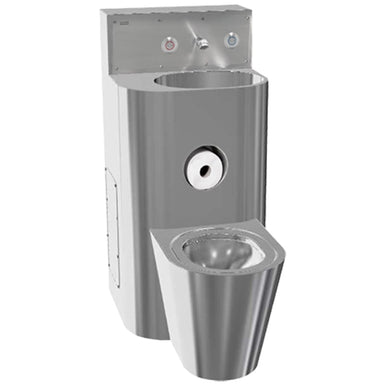
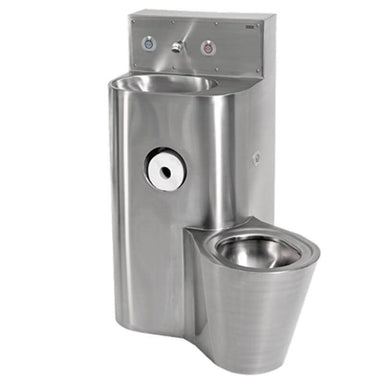
| Combination units | On the wall, or through the wall from a duct | 615 to 890 | 304 or 1.4301, 2.0 mm body | Built in cistern or flush valve | About £2,250 |
Regulations and standards
BS EN 997 sets how WC pans and suites with an integral trap are built and perform, including their key dimensions, with test methods. Delabie states that 11 of its pans here are CE marked and meet EN 997 with a 4 litre flush. They are the BCN S, S21 S, 700 S, BCN P, S21 P, 700 P, S21 S TC, 700 S TC, S21 P TC, Monobloco S21 and Monobloco 700 PMR.
For the Campus CMPX597, CMPX592 and CMPX594, the KWC DVS sheets give flushing certified to EN 997 with a minimum of 4 litres, and a mounting plate made to EN 33, which sets the connecting dimensions of WC pans.
Approved Document M Volume 2 covers buildings other than dwellings in England. For a wheelchair accessible unisex toilet, its Diagram 18 puts the front of the pan 750 mm from the back wall and the pan's centre 500 mm from the side wall. Diagram 19 puts the seat at 480 mm, subject to the pan's manufacturing tolerance. The pan should take a variable height seat riser, and pans made to the key dimensions of BS EN 997:2012 are acceptable. Our 750 mm pan is the Pland Monaco, whose sheet cites no standard, and no sheet claims compliance with Approved Document M.
In England and Wales, the Water Supply (Water Fittings) Regulations 1999 limit a single flush to 6 litres, and a dual flush's reduced flush to two thirds of its full flush (Schedule 2, paragraph 25). The limit applies to whatever flushes the pan: the Delabie Monobloco cisterns give 6 and 3 litres. Some versions of Delabie's combination unit flush through a valve fed straight from the supply, a pressure flushing valve. It cannot go in a house, needs at least 1.2 litres per second at the appliance, and needs a permanently vented pipe interrupter at least 300 mm above the pan's spillover level.
Where they are used
Public toilets and transport hubs
Where toilets are used unsupervised, choose a shrouded pan, whose steel shroud covers the trap and pipework, or a pan fixed through the wall from a duct. See anti vandal toilets.
Cells and secure units
For cells, choose a pan fixed through the wall from a service duct, or a combination unit with the toilet and basin in one stainless steel unit. Delabie's unit is 2 mm steel, and Delabie calls it suitable for prisons and police stations. The KWC DVS units run through a washroom control box, so plan for power. See prison toilets and prison toilet sink combo.
Hospitals and care homes
One floor standing pan suits heavier users: its seat is rated to 362 kg and the pan to 1,000 kg without the seat. Check your disinfectant first: Delabie rules out chlorine cleaners, and Pland allows bleach only diluted and rinsed off at once. See disabled toilets.
Frequently asked questions
Are stainless steel toilets good?
For washrooms where toilets get misused or must last, yes. Through the wall pans, which Delabie calls vandal resistant, fix from a service duct, and Delabie gives a 30 year warranty on all its products. Pland says scratches blend in with age without harming corrosion resistance. The trade off is a higher price than vitreous china and milder cleaning.
What is the price of a stainless steel toilet?
Our stainless steel toilets cost from about £680 to £1,660 ex VAT, or about £820 to £1,990 with VAT at 20%, which is added at checkout. Wall hung pans start at about £680, accessible pans at about £700, floor standing back to wall pans at about £770 and close coupled toilets at about £1,190. Combination units cost about £2,250 to £4,120 ex VAT. Delivery takes 1 to 3 working days, free to England, Scotland and Wales, and we price match: see our price match guarantee.
Which material is best for a toilet?
Stainless steel, where toilets get misused or must last, and vitreous china, where they do not and cost matters most. Vitreous china pans start at about £420 ex VAT and stainless steel pans at about £680. Our commercial toilets range carries vitreous china, composite and stainless steel pans side by side.
What is the disadvantage of stainless steel?
Price and care. Stainless steel costs more than vitreous china, and most of our stainless pans come without a seat. The steel also needs mild cleaning: Delabie rules out abrasive, chlorine and acid cleaners, and Pland rules out wire wool and warns that undiluted bleach left on the steel can cause black pit marks and permanent damage.
Are stainless steel toilets more hygienic?
We do not claim they are: no data sheet here compares stainless steel with vitreous china for hygiene. Delabie calls its 304 steel bacteriostatic and presses each bowl in one piece with no seam, and the Delabie and KWC DVS pans have a concealed flushing rim. For routine cleaning, Delabie asks for slightly soapy water and a soft cloth or sponge, then a rinse and a dry.
Is 304 or 316 stainless steel better for a toilet?
Grade 316 resists corrosion better where chlorides are present, but our pans are 304. Its molybdenum gives it more resistance to pitting and crevice corrosion in chloride environments, and it is usually called marine grade, though it is not fully resistant to sea water. Pland warns that chlorides, found in bleach and sterilising products, corrode every grade of stainless steel if left on. Pland makes two of its pans in 316 on request: ask us for lead times.
What size is a stainless steel toilet pan?
Our stainless steel toilet pans are 360 to 370 mm wide where the sheet gives a width. From the wall to the front, wall hung pans are 500 to 700 mm, floor standing back to wall pans 580 to 750 mm and close coupled toilets 620 to 700 mm; accessible pans are 700 or 750 mm. Back to wall pans are 400 to 480 mm high, and close coupled toilets 810 to 895 mm to the top of the cistern. Each product page links the maker's data sheet.